01
Work finished, never billed
The job's done, the van's gone, the invoice never got raised because the certificate wasn't written. Two months later nobody remembers.
$18,410typical unbilled at any moment
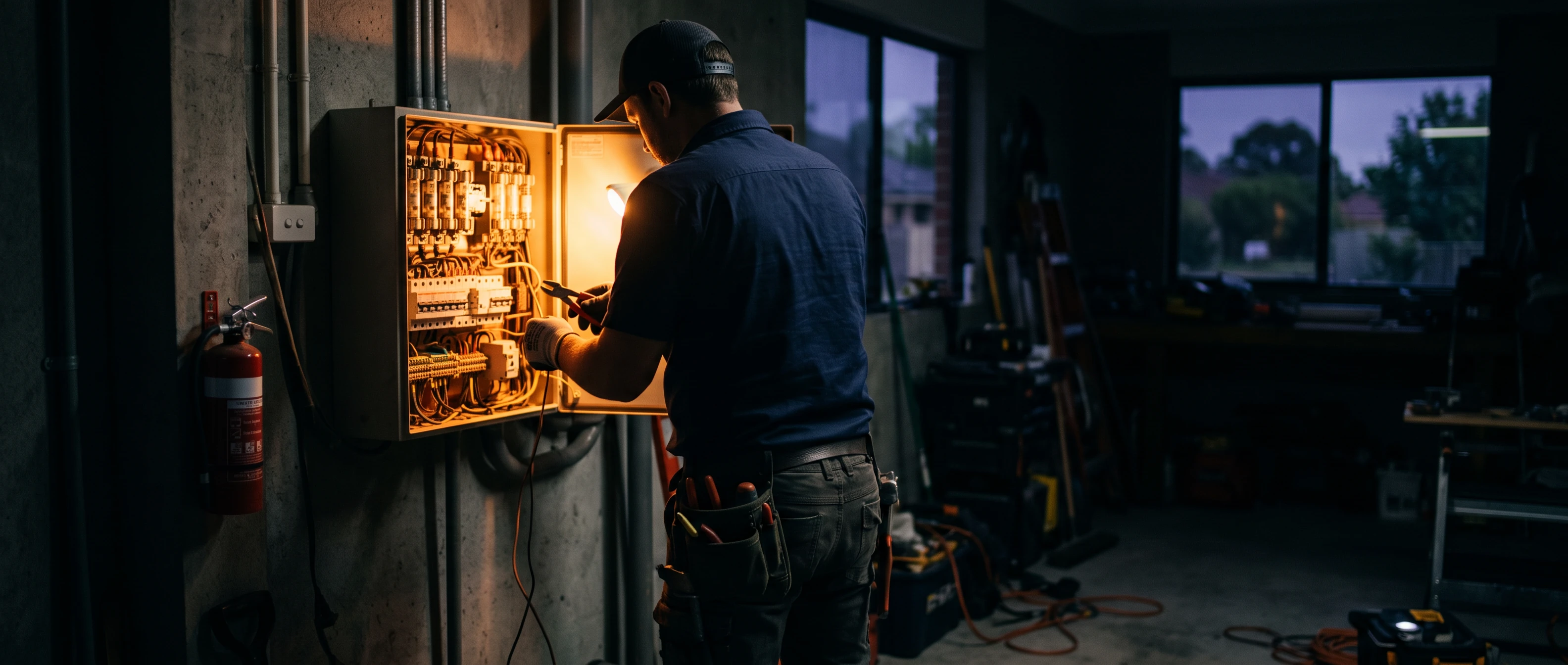
For Australian electrical contractors
Every certificate you owe. Every licence about to lapse. Every job you finished and never invoiced. One system across the desk and the van, built around how your business already runs.
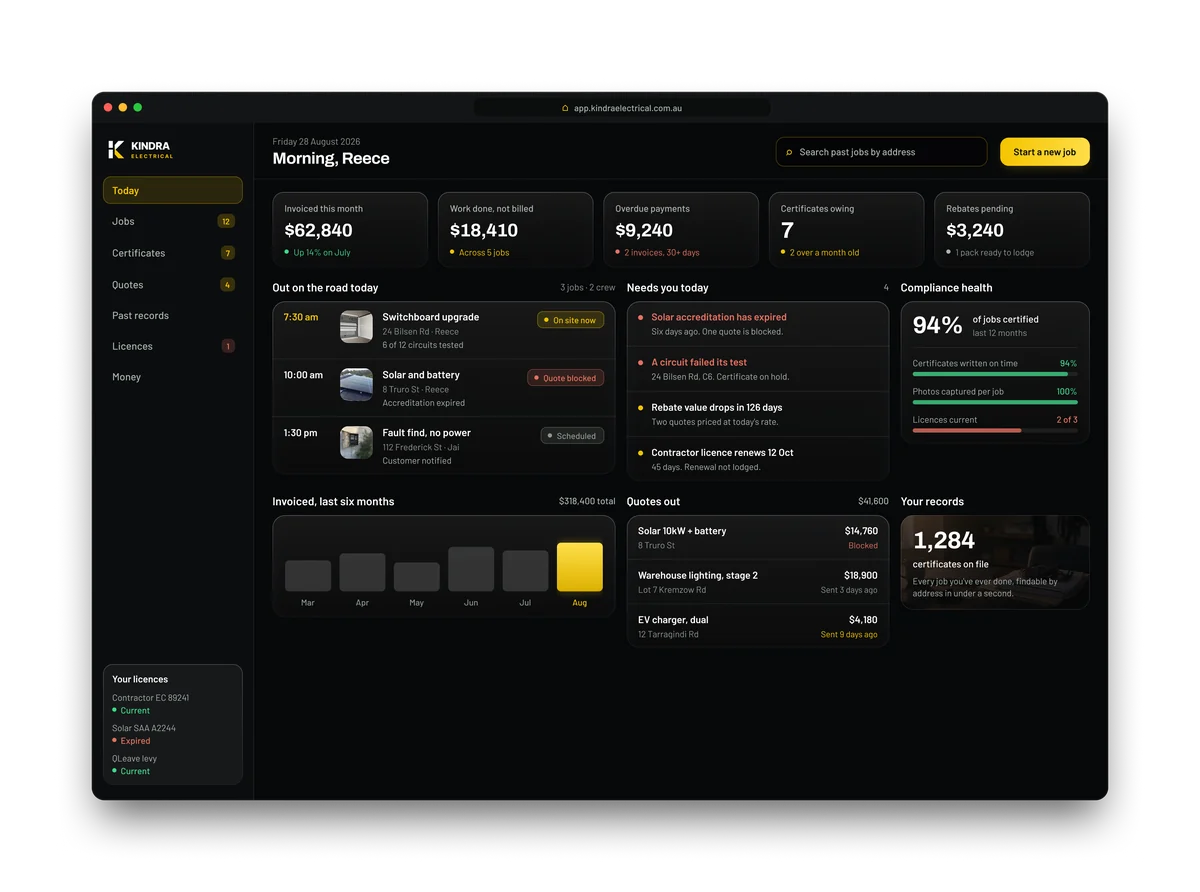 In the office
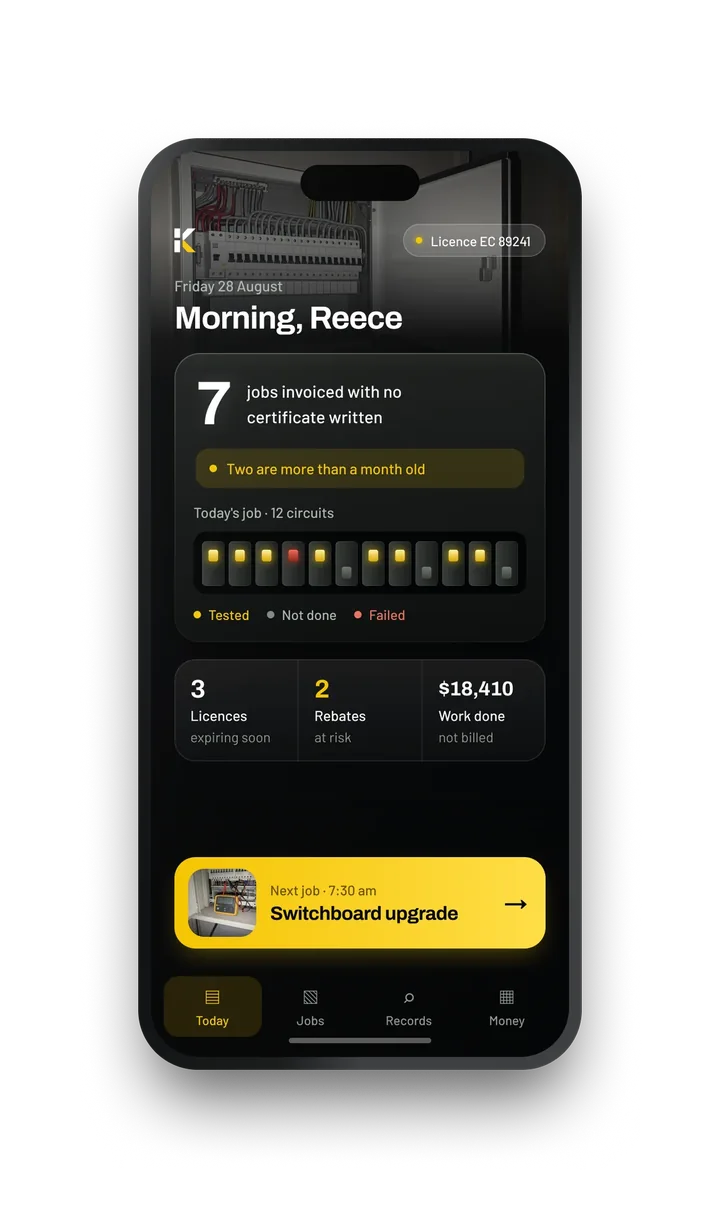 In the van
What it actually costs
The job's done, the van's gone, the invoice never got raised because the certificate wasn't written. Two months later nobody remembers.
Solar accreditation expires on a Tuesday. Nobody notices until a rebated quote gets rejected and the customer asks why.
Somebody disputes work from four years ago. You're searching a ute console, three phones and an old laptop.
The rebate audit lands two years after the install. Serial numbers and photos get pieced together from memory. That's where claims get clawed back.
In the field
Circuit results go in as you test. Insulation, loop impedance, RCD trip time — recorded against the circuit, not scribbled on the back of a docket.
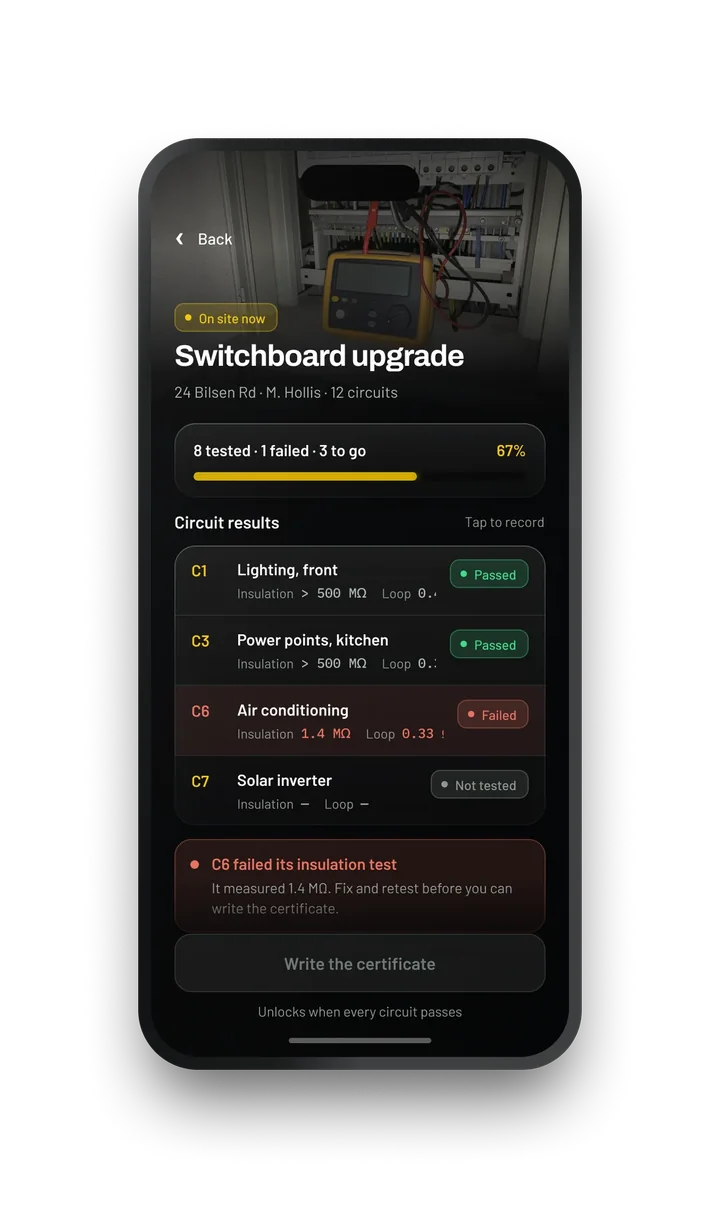
Nothing in this system is coloured to look nice. If it's lit, it's energised or it's outstanding. Your crew learns that in a morning.
In the office
Not a wall of charts. Money in, work you've done but haven't billed, what's overdue, who's on the road, and the four things that will cost you if today goes by.
Every screen, explained
This is a complete build for one contractor — not a feature list. Every screen below is real, and every one is clickable if you want to read the detail on it.
In the van, at the board, gloves on
Seven screens built for one thumb and bright sunlight. Big type, plain English, and nothing that needs a keyboard.
The first thing you see at 6am
Not a menu. A number. Seven jobs invoiced with no certificate written, and two of them are more than a month old. Underneath it, today's job broken into twelve circuits — yellow for tested and passed, red for failed, grey for not done yet.
Recording tests as you do them
Every circuit gets its readings entered against it — insulation resistance, loop impedance, RCD trip time. Measured values are set in monospace so digits line up and you can scan a column without misreading a decimal point.
Issued, filed and sent before you leave
The certificate renders on a real paper background so it reads as a document, not a form. Address, work done, who tested it and under which licence, the date written and the date it must be kept until.
Answering a four-year-old question in a second
Type an address. Everything you have ever done there comes back, newest first, with a thumbnail from the job and whether the certificate is on file or the job is still open.
The screen that stops a costly mistake
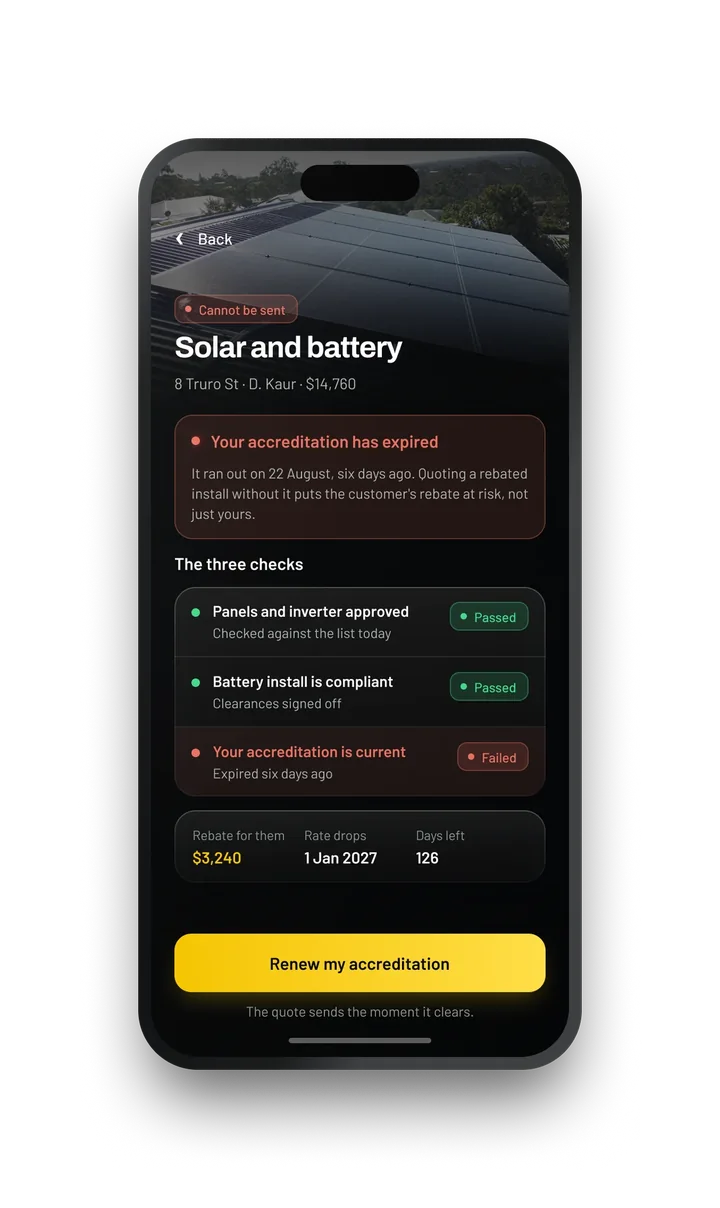
A solar quote that cannot be sent, and it says exactly why. Three checks run before any rebated install — panels and inverter on the approved list, battery install compliant, your accreditation current. Two passed. One did not.
Where everyone is, and what is stuck
Seven days across the top with today lit. Below it, the day's jobs with times, crew, a photo and a live status — on site now, quote blocked, booked.
Licence numbers on the door
A dark, quiet entry screen over a photograph of tools on a van floor. The line underneath is the promise the whole system makes: every circuit you have tested, still on file.
At the desk, running the business
Eight screens that answer where the business stands, what it owes, and what will cost money if today goes by.
The whole business, one screen, no scrolling
Five numbers across the top: invoiced this month, work done but not billed, overdue payments, certificates owing, rebates pending. Underneath, who is out on the road, the four things that need you today, and compliance health as a single percentage.
Queue on the left, the job on the right
A split work surface. The left column is every job waiting on a certificate. Select one and the right side fills with a wide photograph of the site, the blocker stated plainly, and the real circuit results table.
What you owe, oldest first
Four counters, then a table of every job finished but not certified — sorted by how long it has been waiting, because that is the number that hurts. Beside it, a plain reminder of the four things every certificate must contain.
Pipeline, and what is blocking one of them
Quotes out on the left with values and status. Select the blocked one and the right side explains itself: the three checks for a rebated install, which one failed, and the full price breakdown showing what the customer pays after the rebate.
1,284 certificates, findable by address
One search field, prominent, with the result count and how long it took. Underneath, every job at that address as a full card — date, who did it and under which licence, and a sentence of what was actually done.
Twelve months of runway on one timeline
Every licence, accreditation, calibration and insurance on a single horizontal timeline. Green means comfortable, yellow means it is approaching, red means it has already lapsed and something has stopped.
Unbilled work, and why two are held back
Five money counters, then a table of work you have done but not billed, worth $18,410 in this build. Two of them are deliberately held — the certificate is not written yet, and this system will not let you invoice before you certify.
Twelve evidence items, gathered on the day
Everything an auditor will ask for about a solar install, captured while the van was still in the driveway. Eleven items held, one missing — and the missing one is the reason the claim cannot be lodged.
The part that wins the next job
Four screens your customer receives. Most contractors send nothing between quote and invoice. This is the gap.
Twelve minutes out, with your licence on it
Your customer gets a screen, not a vague text. Who is coming, what their licence number is, what the job is, and how long their power will be off.
Certificate and photos, handed over on site
The moment the job is certified, your customer gets the document and the photographs. Not a promise to email it later — the thing itself, on their phone, before you drive away.
One price, what it includes, one button
The price they actually pay, with the rebate already taken off and shown as a line item so it reads as a discount you obtained for them. Then what they get, in plain language, with a photo against each item.
The repeat work most sparkies never chase
Two years after you tested their safety switches, the system tells them it is due — and shows the results from last time, including how many milliseconds each switch took to trip.
How we build
Every electrical business runs differently. Some do domestic service, some do commercial fit-out, some live and die on solar rebates. The screens on this page are one build for one contractor. Yours will share the bones and almost nothing else.
Twenty minutes. Free meeting. We map where the money and the hours are actually going. You get the findings whether you hire us or not.
We write down exactly what gets built, what it costs, and how we'll know it worked. Fixed scope, fixed price, no surprises.
Your screens, your terminology, your workflow. If your team calls it a "sparky sheet", the system calls it a sparky sheet.
We come back to the numbers we promised to move. If they didn't move, that's our problem to fix.
Book a free meeting
Twenty minutes in a meeting. We map where the money and the hours are actually going in your business. You keep the findings whether you hire us or not.
Straight answers
What is a Leak Check? The tool we use inside a free 20-minute meeting when the drag looks like money walking out the door — certificates, jobs, unpaid invoices. One instrument, not the whole Kindra offer. Book at kindraai.dev/book.
How long / is it free? Free. Locked at 20 minutes. We call it a meeting, not a sales call.
What do I walk away with? Even if we never work together, you walk away knowing where the time and money go. Findings stay yours. About 40% don't lead to a proposal.
How do I book? kindraai.dev/book, ring 0403 475 099, or email hello@kindraai.dev with one annoying job.
Certificates → jobs → paid — where's the leak? Often unfinished certificates, jobs that don't get invoiced cleanly, and compliance admin that eats the week. When that looks like revenue leaking, we run a Leak Check inside the meeting.
Rather just call? 0403 475 099 or email hello@kindraai.dev
We'll be in touch within one business day.
The rest of the family
Each one is the same idea — your quoting, your jobs, your invoicing, in one system you own — fitted to how that trade actually works. Built in Brisbane by Kindra AI.